
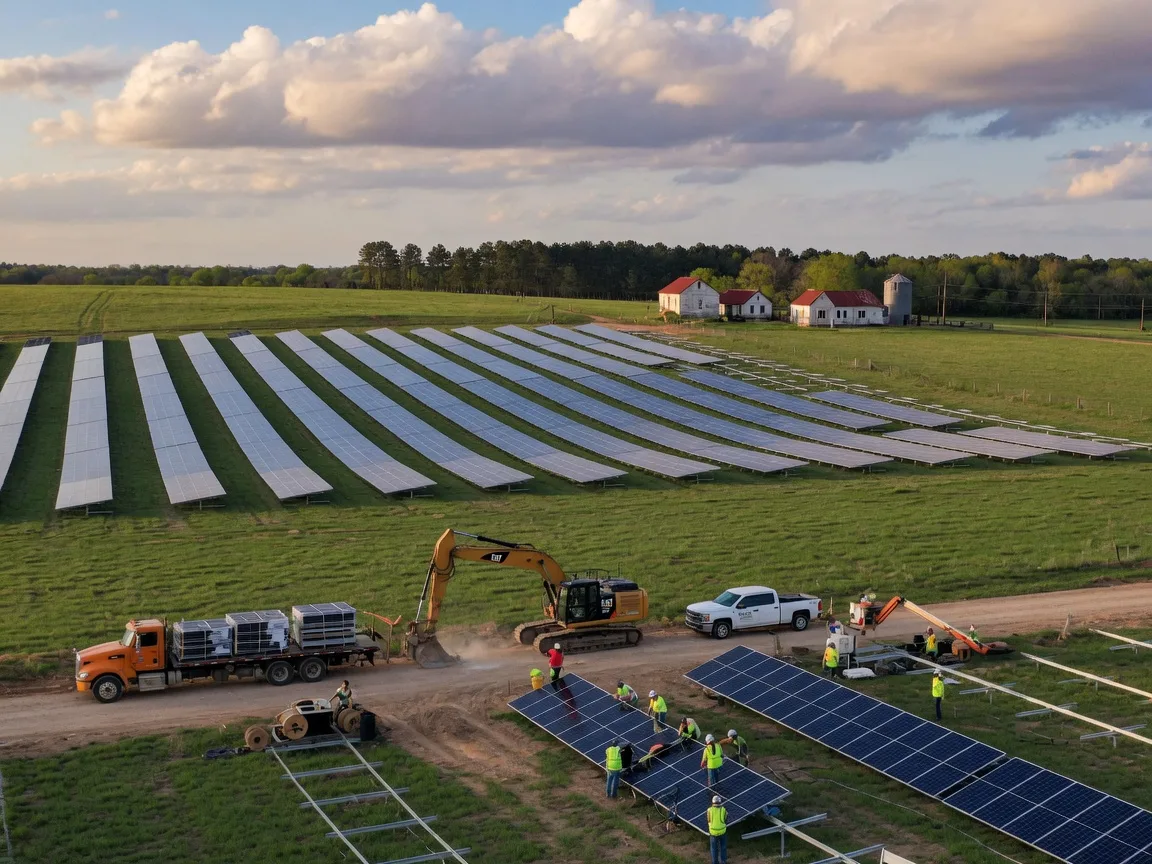
Sunraycer Breaks Ground on 620 MW Solar Portfolio in Lamar County
When two separate developers commit over $1.5 billion combined to solar projects in Lamar County, the market has crossed an unmistakable threshold. It is no longer an emerging energy destination. It is an active build site.
Sunraycer Renewables LLC has broken ground on the Lupinus I & II Solar and Battery Energy Storage projects in Hagansport, Lamar County, alongside the Eagle Springs Solar & BESS facility in Delta County. Together, the portfolio delivers more than 620 MWdc of solar generation and over 475 MWh of battery storage capacity, representing a total project financing commitment of $901 million. This is a distinct and separate investment from the Zelestra 441 MWdc solar portfolio already under construction in Lamar and Hopkins counties, meaning Northeast Texas is now the site of over 1 GW of active solar development.
Lupinus I & II account for 520 MWdc of solar capacity paired with 411 MWh of storage, located in the Hagansport community of Lamar County. The Eagle Springs project contributes an additional 100 MWdc of solar and 66 MWh of storage in nearby Delta County. McCarthy Building Companies serves as the EPC contractor across the portfolio, with Sunraycer having secured long-term power purchase agreements with Google for the Lupinus projects. Full commercial operations at Eagle Springs are expected in late 2026, with Lupinus I & II targeting early 2028.
The financing and scale
The $901 million portfolio financing confirms the institutional confidence in Northeast Texas as a market for long-duration energy infrastructure. The projects are expected to support more than 200 local construction jobs during peak building phases, with career pathways created through McCarthy's apprenticeship program into skilled energy trades. Sunraycer has emphasized local hiring and regional supplier engagement across the project communities.
When added to the Zelestra portfolio's $600 million backing and 400-plus construction jobs, Lamar County is now host to over $1.5 billion in active utility-scale energy investment. These are not speculative land plays. These are financed, permitted, under-construction projects with creditworthy off-take partners.
What solar build-out means for commercial property
Utility-scale solar construction creates a concentrated wave of economic activity. During the build phase, hundreds of workers travel into the area and need lodging, food services, fuel, and supply chains. The Lupinus projects' build timeline extending into 2028 means this demand is multi-year, not seasonal. For commercial property owners in Paris, that translates to immediate, measurable demand for short-term housing, hospitality, flex commercial space, and professional services.
Once operational, the solar facilities generate tax revenue and require ongoing maintenance staffing, but the more significant commercial impact may be the signal it sends to other developers. When two major energy portfolios choose the same small county, they validate the workforce, the road network, the utilities, and the community's willingness to host large-scale infrastructure. That validation carries across sectors. If the grid and labor market can support a 520 MW solar facility, they can support a manufacturer, a logistics hub, or a data center.
Source: Solar Power World, "Construction underway on 620-MW solar project portfolio in Northeast Texas," March 2026. PR Newswire, "Sunraycer celebrates start of construction of Lupinus I & II and Eagle Springs," March 2026. PV Tech, "Sunraycer breaks ground at 620MW solar-plus-storage portfolio in the US," March 2026.
Visit
More than a billion dollars in motion.
Two solar portfolios, one county. The infrastructure build-out supports commercial property values across Paris. Tour the site and see how it connects.
Schedule a tour